CAM charges explained: what's included and how to calculate them
What CAM charges are, what's included and excluded, how to calculate a tenant's share and admin fee, estimates vs. reconciliation, caps, and bill review.
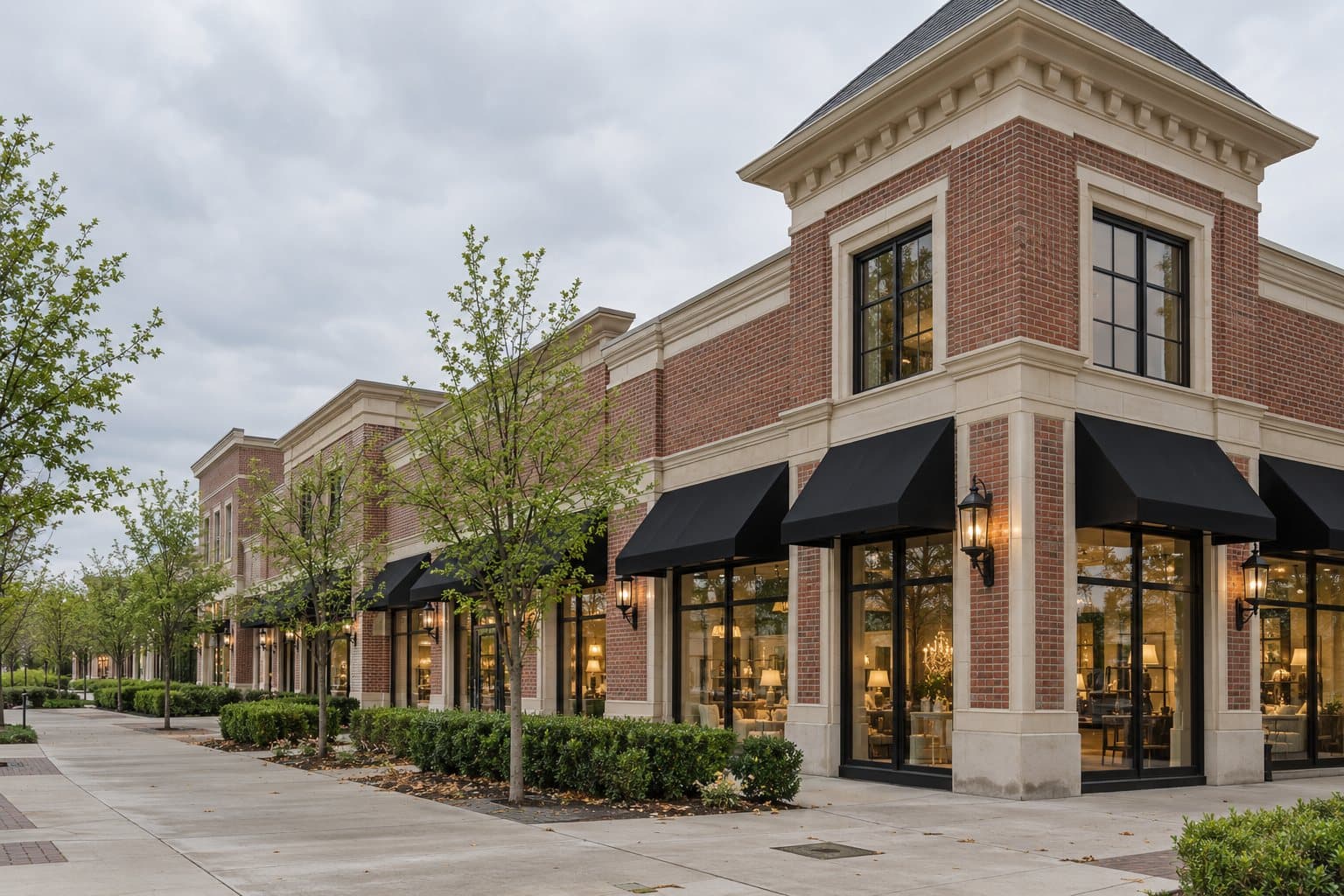
CAM charges are a commercial tenant's share of the cost of running a property's shared areas, such as the parking lot, landscaping, snow removal, common lighting, and security, paid on top of base rent. They're usually calculated by multiplying the tenant's pro-rata share (its square footage divided by the building's) by the year's recoverable CAM costs, billed as monthly estimates, and trued up once a year. If base rent is the price of the space, CAM is the price of everything around it. This guide covers what goes in, what should stay out, how the math works with an admin fee, what CAM costs per square foot (and why a national average is mostly fiction), and how tenants can review a CAM bill without starting a war.
01 / 09
What CAM charges are
CAM stands for common area maintenance. CAM charges, also called CAM fees or CAM expenses, reimburse the landlord for operating the parts of a property that all the tenants share and no single tenant leases: the parking lot, sidewalks, landscaping, exterior lighting, shared hallways and restrooms, and the services that keep them usable.
CAM is one of the three “nets” in a triple-net lease, alongside property taxes and building insurance. Some leases bill the three separately; others fold taxes and insurance into a single operating expense charge that people still loosely call CAM. So when a tenant says “my CAM went up,” the first question is which of those it means. Many modified-gross leases pass CAM through too, sometimes only the increase above a base year.
CAM charges are usually defined as additional rent. In most leases that means they're due like rent, and unpaid CAM can be a default just like unpaid rent.
Key points
- Base rent: the negotiated price of the space
- CAM: a share of the shared areas' operating costs
- Taxes and insurance: the other two nets, billed separately or together with CAM
- The tenant's own utilities: usually metered and paid directly, not CAM
02 / 09
What's included in CAM, and what usually isn't
The lease's definition of common area costs decides what's recoverable, not the landlord's general ledger. That said, most CAM pools draw from the same list, and our guide to common-area-maintenance expense categories walks through each one. The fights happen in the middle and right-hand columns.
Two rules of thumb hold almost everywhere. If an expense mostly benefits the landlord's equity or leasing effort, it usually isn't CAM. If it's a capital item, the lease decides whether it's excluded, amortized over its useful life, or recoverable in full; our guide to CAM caps and exclusions covers how those carve-outs work.
| Usually included | Often excluded or limited | Negotiated case by case |
|---|---|---|
| Landscaping and grounds | Capital replacements, like a new roof or full repaving | Capital items amortized over their useful life |
| Snow and ice removal | Leasing commissions and marketing vacant space | The management or admin fee |
| Parking lot sweeping, striping, and repairs | The landlord's mortgage and income taxes | Security upgrades |
| Common-area utilities and lighting | Costs caused by one tenant or another tenant's space | Reserves for future repairs |
| Common-area janitorial and trash | Fines and penalties from the landlord's own negligence | Marketing or promotional funds |
| Security, fire, and life-safety inspections | Repairs paid by insurance or a warranty | Insurance deductibles |
03 / 09
How to calculate CAM charges
The arithmetic is three steps. The judgment calls are in the inputs, which is why the formula fits on a sticky note and the disputes fill binders.
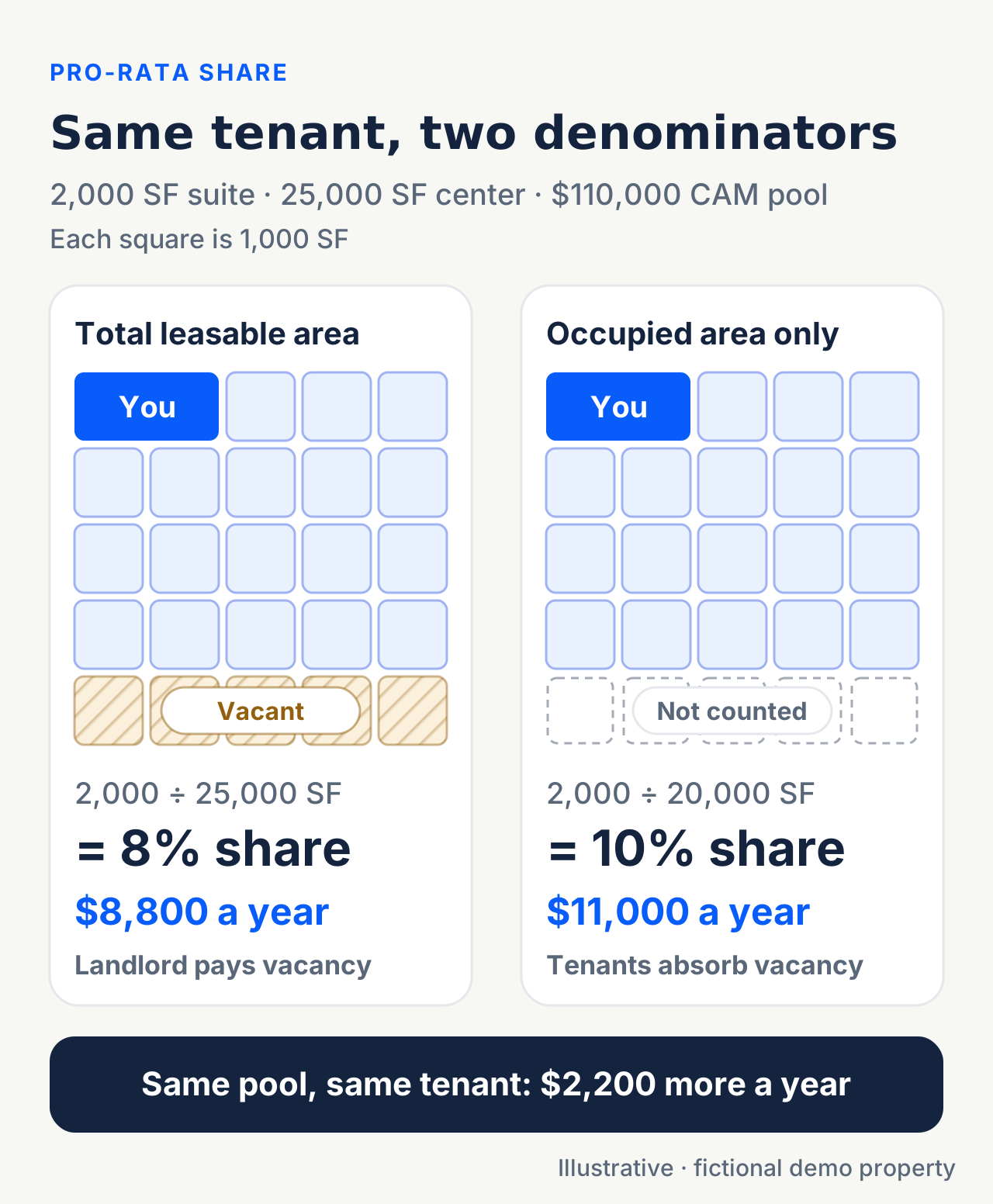
The denominator matters more than it looks. Dividing by the building's total leasable area means the landlord pays the vacant suites' share. Dividing by occupied area spreads it across the tenants who are there. The free pro-rata share calculator shows a tenant's share under each denominator a lease might use, and the dollar difference on this year's pool.
Key points
- Step 1, the pool: add up the year's recoverable common area costs under the lease's definition
- Step 2, the share: divide the tenant's square feet by the denominator the lease names, usually the building's total leasable area
- Step 3, the fee: add any administrative or management fee the lease allows, applied to the base the lease names
- Then: annual CAM = (pool + admin fee) × pro-rata share, and the monthly estimate is one-twelfth of the budgeted amount
04 / 09
A worked example, admin fee included
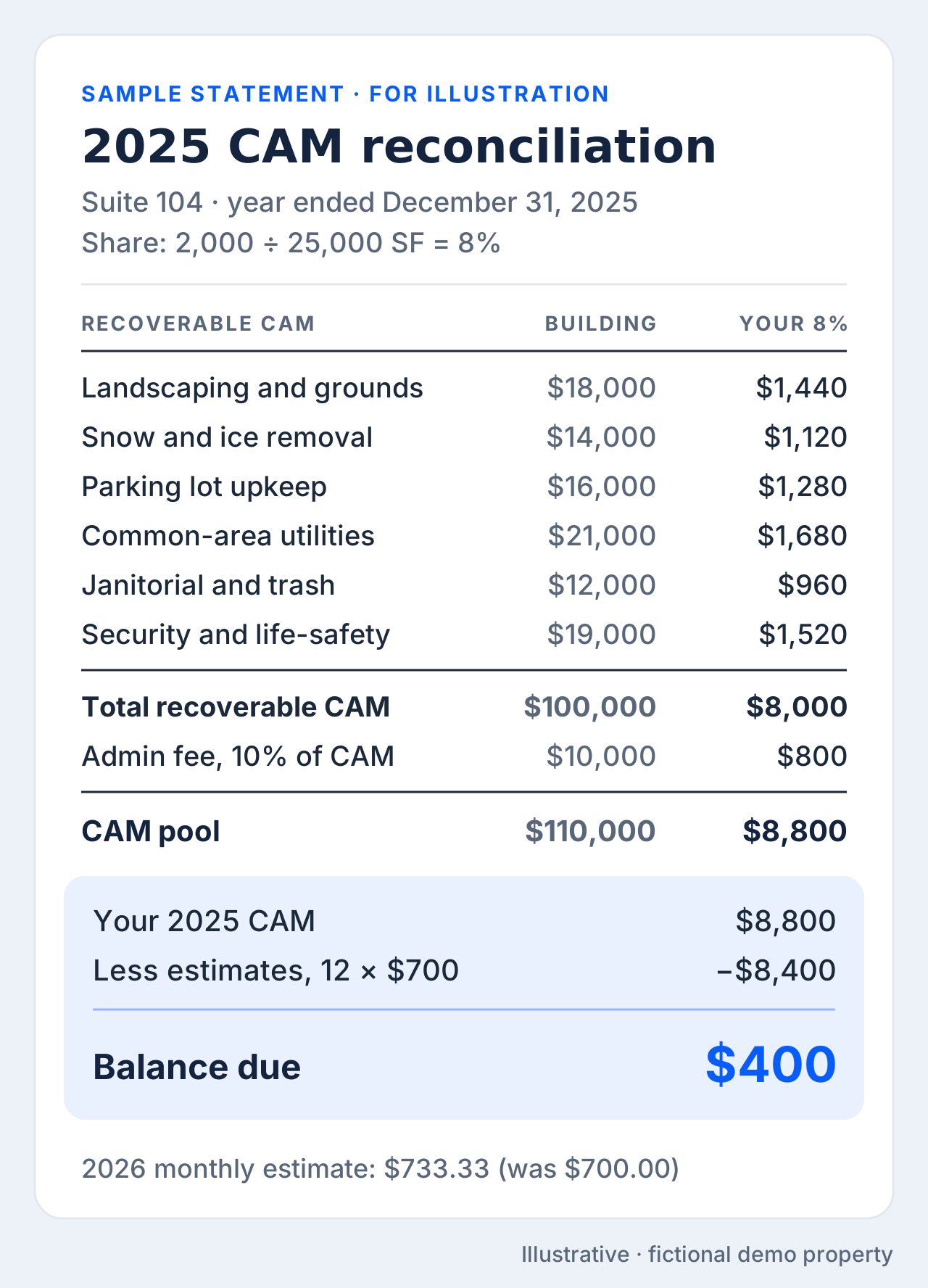
A 2,000 square foot tenant leases space in a 25,000 square foot center, so its pro-rata share is 2,000 ÷ 25,000 = 8%. This year's recoverable CAM pool is $100,000. The lease allows a 10% administrative fee on CAM, which adds $10,000, for $110,000 in total.
The tenant's CAM is $110,000 × 8% = $8,800 a year, or $733.33 a month, which works out to $4.40 per square foot. Without the admin fee it would be $8,000, so the fee costs this tenant $800 a year.
Now change one word in the lease. If the share is measured against occupied area and 5,000 square feet sit vacant, the denominator is 20,000, the share is 10%, and the same pool produces $11,000 for this tenant: $2,200 more for the same parking lot.
Key points
- Pro-rata share: 2,000 ÷ 25,000 = 8%
- Pool with admin fee: $100,000 + 10% = $110,000
- Annual CAM: $110,000 × 8% = $8,800 ($733.33 a month, $4.40 per SF)
- The admin fee's cost to this tenant: $800 a year
- Occupied-area denominator: $110,000 × 10% = $11,000, or $2,200 more
| Denominator | Tenant's share | Annual CAM | Per SF per year |
|---|---|---|---|
| Total leasable area (25,000 SF) | 8% | $8,800 | $4.40 |
| Occupied area (20,000 SF) | 10% | $11,000 | $5.50 |
05 / 09
What CAM charges cost per square foot
Search for an average CAM charge and you'll find confident numbers. Treat them gently. CAM depends on the property type, the region, the age of the property, the services provided, the weather, and above all on what the lease counts as CAM. A national average blends a gravel-lot strip center in Arizona with a heated-sidewalk lifestyle center in Minnesota.
The spread is wide even within retail. In a 2023 article for the International Council of Shopping Centers (ICSC), a retail tenant-representation executive described CAM ranging from about $2 to $3 a square foot in a small neighborhood center to upward of $50 a square foot in a high-end lifestyle center. The same article made the more useful point: two spaces at the same $25 base rent can cost very different amounts if one carries $3 of CAM and the other $10.
On a 2,000 square foot space, that's $6,000 a year of CAM against $20,000, a $14,000 difference that never appears in the headline rent. So instead of comparing to an average, compare total occupancy cost (base rent plus every net) across the spaces you're actually considering, and ask each landlord for the last two or three years of actual CAM, not just this year's budget.
| Per year | Space A | Space B |
|---|---|---|
| Base rent at $25 per SF | $50,000 | $50,000 |
| CAM | $6,000 ($3 per SF) | $20,000 ($10 per SF) |
| Base rent plus CAM | $56,000 | $70,000 |
06 / 09
Estimates now, reconciliation later
Landlords don't know this year's CAM until the year is over, so they bill monthly estimates based on a budget, then compare them with actual costs after year-end. If the tenant's share of the actual costs is higher than what it paid, it gets a bill; if lower, a credit. That annual true-up is the CAM reconciliation, and our guide to CAM reconciliation walks through it step by step.
In the example, suppose the landlord estimated $700 a month, or $8,400 for the year. Actual CAM came to $8,800, so the reconciliation bills the tenant $400. Next year's estimate should move to about $733 a month, plus any known increases, so the next true-up is small.
Big reconciliation bills are usually an estimating problem, not an expense problem. A landlord who updates estimates when a new snow contract or a big repair lands spares everyone a surprise in March.
07 / 09
CAM caps: limits on how fast CAM can grow
A CAM cap limits how much a tenant's CAM, or part of it, can rise from one year to the next. Most caps apply only to controllable expenses, the ones the landlord can shop or manage, like landscaping, janitorial, and general repairs. Taxes, insurance, utilities, and snow removal are usually treated as uncontrollable and pass through uncapped.
Say a lease caps controllable CAM increases at 5% a year, and the tenant's controllable share was $5,000 last year. This year's ceiling is $5,250, no matter what the landlord spends. Whether unused room carries forward (cumulative) or resets from last year's bill (non-cumulative) changes the answer over time; our guide to CAM caps and exclusions works through both, and the CAM cap calculator builds the year-by-year table.
08 / 09
How tenants should review CAM charges
Most CAM errors are honest: a cost coded to the wrong property, a denominator that drifted, an admin fee charged on taxes. Tenants find them by asking the same questions every year.
If something looks wrong, ask in writing for the invoices behind that line. Most questions end there. If they don't, the lease's audit clause sets the process, and our guide to handling a CAM dispute covers it from the landlord's side.
Key points
- Ask for the budget before the year starts and the actual expense detail after it ends
- Check the pro-rata share: your square feet, the denominator, and whether either changed
- Look for excluded items: capital projects, leasing costs, the landlord's legal fees, insurance-covered repairs
- Check the admin fee: the percentage, and which costs it's applied to
- Compare year over year, and ask about any category that jumped
- Note the audit window in the lease and send written questions inside it
09 / 09
For landlords: CAM bills tenants don't fight
Tenants accept CAM charges they can understand. Send the reconciliation on time, show the categories and the math, attach or offer the backup, and explain any big change in a sentence. Keep each tenant's share, cap, exclusions, and admin fee next to the numbers, so nobody has to reread a lease to answer a simple question.
FAQ
Frequently asked questions
What are CAM charges?
CAM charges are a commercial tenant's share of the costs of operating and maintaining the property's shared areas, such as the parking lot, landscaping, snow removal, common lighting, and security. They're paid on top of base rent, usually as monthly estimates that are reconciled once a year.
What does CAM stand for in a commercial lease?
CAM stands for common area maintenance: the shared parts of a property that no single tenant leases, and the cost of operating them. CAM charges, CAM fees, and CAM expenses all refer to the tenant's share of those costs.
How are CAM charges calculated?
Add up the year's recoverable common area costs, add any admin fee the lease allows, and multiply by the tenant's pro-rata share, usually its square feet divided by the building's. A 2,000 square foot tenant in a 25,000 square foot center has an 8% share, so a $110,000 pool including the admin fee costs it $8,800 a year.
What is included in CAM charges?
Commonly landscaping, snow removal, parking lot maintenance, common-area utilities and lighting, janitorial, trash, security, and repairs to shared areas, plus an admin fee if the lease allows one. Capital replacements, leasing costs, and the landlord's financing costs are commonly excluded. The lease's definition controls.
Are CAM charges included in rent?
Usually not in base rent. In triple-net and many modified-gross leases, CAM is billed as additional rent on top of base rent. In a full-service gross lease, operating costs are built into the rent instead, sometimes with increases above a base year passed through.
What is a typical CAM charge per square foot?
There's no reliable national number, because CAM depends on property type, location, services, and what the lease counts. In one 2023 ICSC article, a retail tenant representative described a range from about $2 to $3 a square foot in small neighborhood centers to upward of $50 in high-end lifestyle centers. Ask for two or three years of actual costs instead.
Are CAM fees negotiable?
Yes, mostly before signing. Tenants commonly negotiate caps on controllable expenses, exclusions for capital and leasing costs, the admin fee percentage and its base, audit rights, and which denominator sets their share.
Can CAM charges go up?
Yes. CAM follows actual costs, so a new landscaping contract, a snowy winter, or higher utility rates raise it. A cap can limit increases in controllable expenses, but uncontrollable costs like snow removal and utilities usually pass through in full.
Who pays CAM on vacant space?
Usually the landlord, if each tenant's share is measured against the building's total leasable area. If the lease measures shares against occupied area, the vacant space's share shifts to the tenants who are there. The lease's denominator decides it.
Can a tenant audit CAM charges?
Often, yes, if the lease grants audit rights, usually within a set window after the reconciliation is delivered. Even without a formal audit clause, asking for the invoices behind a questionable line item is reasonable and usually resolves it.
Free template
Get the CAM reconciliation worksheet
The spreadsheet version: recoverable pool, each tenant's share, caps, proration, admin fee and the true-up balance. Comes with the reconciliation and audit checklists.
- CAM reconciliation worksheetSpreadsheet template
- CAM Reconciliation ChecklistPrintable checklist
- CAM Audit Checklist for Landlords and TenantsPrintable checklist
Put it into practice
TenantPoint handles this workflow in CAM reconciliation software and Commercial lease management software. See all TenantPoint solutions or how it compares with other software.
Sources
Where the numbers come from
This educational material is not legal, accounting, tax, or investment advice. Review controlling lease language and consult qualified professionals when appropriate.
Back to resources